
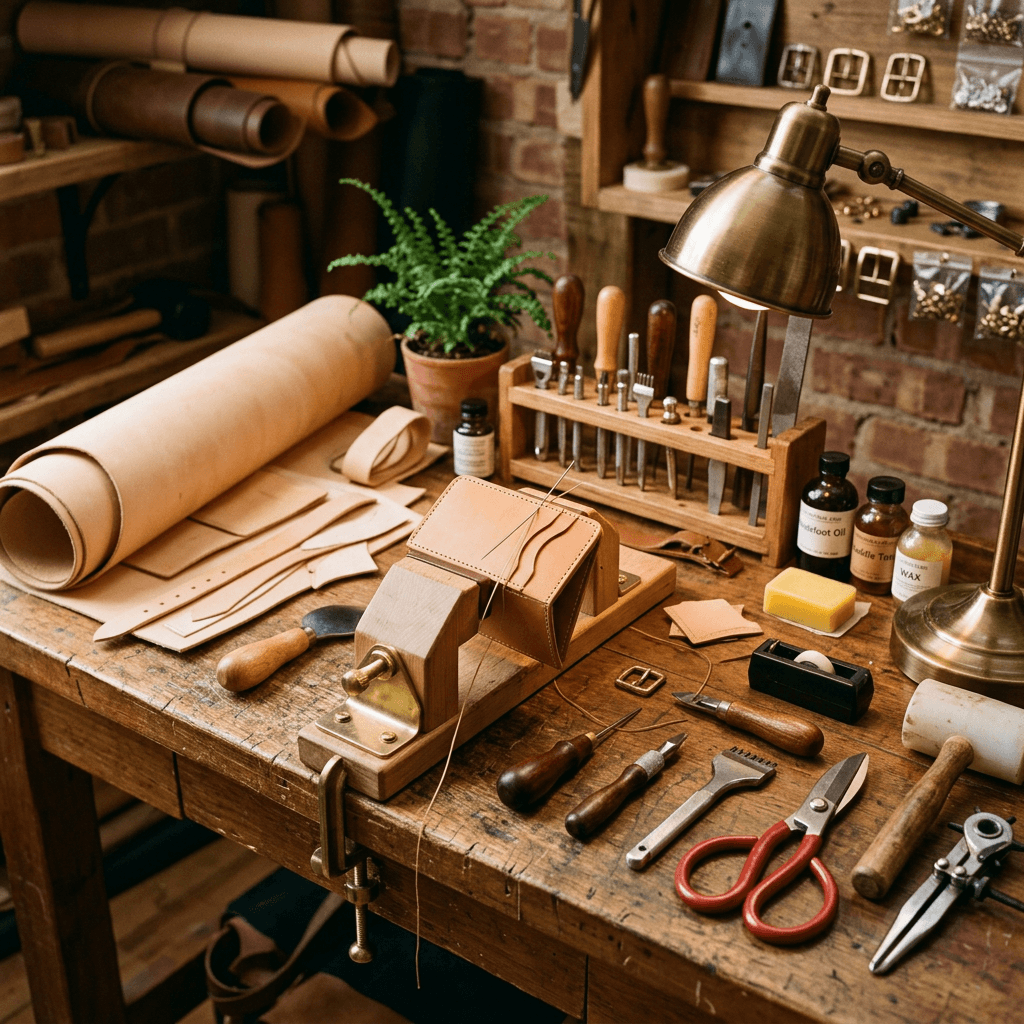
Leatherworking always seemed like a craft that belonged to a different era… something for cobblers and saddlers and people who own horses. Then I watched one too many videos of someone hand-stitching a perfectly finished bifold wallet at their workbench, smelling of leather and looking impossibly cool, and I decided I needed to try it immediately.
That was eight months ago. Since then I’ve made eleven wallets, twenty-some keychains, two belts, and a notebook cover I’m particularly proud of. I’ve also punched through the wrong piece of leather twice, glued my fingers together once, and learned more about different types of leather than I ever expected to need to know.
Here’s my honest beginner’s guide — what I wish I’d known before I started, and how to make your first two projects: a simple keychain and a slim card wallet.
Why Leatherworking Is More Beginner-Friendly Than You Think
The reputation leatherworking has — expensive, technical, slow — is partially true and partially overstated. Yes, a full professional leather setup with a stitching horse, skiving knife, and burnishing wheel runs hundreds of dollars. But for your first projects? You need about $40 in tools and a piece of leather the size of a piece of paper.
Leather is also one of the most forgiving materials I’ve ever worked with. Unlike fabric, it doesn’t fray. Unlike wood, it doesn’t split if you look at it wrong. Mistakes can often be hidden on the inside of a project, and even imperfect work has that quality of real leather that makes it look handmade in the best possible way.
Start small. Make a keychain. Make a card holder. Then decide if you want to invest in more tools.
Understanding Leather: A Quick Guide So You Don’t Waste Money
Before you buy anything, you need to understand the difference between leather types, because the type matters enormously for beginner projects.
Vegetable-tanned leather (veg-tan) is the gold standard for tooling, carving, and hand-stitched projects. It’s stiff, holds its shape, takes impressions beautifully, and develops a gorgeous patina over time — darkening and softening with age and handling. This is what you want for wallets and keychains.
Chrome-tanned leather is softer, more uniform, and widely used in commercial products. It’s harder to tool and doesn’t take impressions as well, but it’s often more affordable and works fine for simple cut-and-stitch projects.
Bonded leather and PU leather are not real leather — they’re plastic or leather scraps pressed together. Avoid these entirely for any project you care about.
For beginners, I recommend starting with 3–4 oz vegetable-tanned leather (thickness is measured in ounces in leatherworking; 1 oz = 1/64 inch). This weight is flexible enough to fold into a wallet but firm enough to hold structure. You can find it on Amazon in small pre-cut pieces — perfect for getting started without buying a full hide.
The Starter Tool Kit
You don’t need everything right away. Here’s what I’d actually buy to start, in order of importance:
Essential from day one:
- Stitching chisels / pricking irons — for making evenly spaced stitch holes. A 4mm spacing is a good all-around choice.
- Harness needles and waxed thread — hand-stitching leather uses a two-needle saddle stitch. Buy waxed polyester thread in a neutral color to start.
- Mallet or maul — for driving the stitching chisel through the leather
- Cutting mat — protect your work surface
- Leather knife or rotary cutter — for clean, straight cuts
- Ruler (metal) — for guiding cuts
- Binder clips or leather clamps — for holding pieces together while you stitch
- Wing divider or stitch groover — marks a guideline parallel to the edge for your stitch line
Add these when you’re ready to level up:
- Edge beveler — rounds off sharp corners on the cut edges; makes work look immediately more professional
- Gum tragacanth or Tokonole — a burnishing agent that smooths and seals rough leather edges
- Leather cement — for gluing layers together before stitching
- Swivel knife + leather stamps — for decorative tooling and carving
A good starter kit that includes most of the essentials runs about $30–$50 on Amazon, and you can supplement individual tools as you go.
Leatherworking can feel like a big step at first, but it’s a craft that rewards patience. With time, you begin to see progress in every piece you make—whether it’s a simple keychain or a full bag. What starts as a hobby becomes something more: a way to create durable, meaningful items that also make thoughtful gifts.
(Affiliate disclaimer: links help support this blog at no extra cost to you.)

Leave a Reply